Why I cut off my Locs and the politics of Black Hair

In the spirit of Father’s Day, it’s only fitting to shed some light on the politics of Black hair from a man’s perspective. Today, I came across this great read, “Why I cut off my Locs and the politics of Black Hair”, by Rad Dockery, in which he shares the historical, spiritual, and political considerations connected with his decision to grow, and then later cut, his locs.

Rad Dockery's avatarRad Dockery

On Father’s Day, I posted a picture on my Facebook profile of my daughter and myself.   At her daycare, they were having a small father’s day celebration where the toddlers designed a gift for Dad.

Nia Rad

Well this led to my Facebook inbox blowing up.   Not only due to the fact that my daughter is beautiful (yes I am very biased) – but due to the fact that I removed my locs.   All of the sudden, I am getting offers to attend various churches.   The assumption there is that I did this for religious reasons and that I am no longer an ‘evil’ rastaman.

On the other side, there are some who now believe that I am no longer interested in the forward progression of the Black community in Toronto because I cut of my locs.   Or in other words, “I am conforming to White Supremacy”.

View original post 895 more words

The Greatest Love of All

IMG_20150621_0001

My father (and me- sadly, my face didn’t make the cut!)

Why yuh a fry dem hair? (Why are you frying their hair?),” my father would ask my mother on those rare occasions when she would press our hair out.  He couldn’t stand the smell of burning hair coming from the sizzling hot comb on the stove.  “Listen, nuttin’ nuh wrong wit’ yuh hair,” he would tell my sister, Sarah, and me.

My father was all about us keeping our hair in its most natural state: no additions, no alterations, no nothing.  He would even get upset when my mom would braid extensions into our hair! “Unuh a put in di horse hair, again? (You guys are putting in horse hair, again?)” he would question.  He didn’t think that any of that was necessary (even though the fake hair was actually plastic). “Jus’ plait it” was his recommendation.

My father, along with my mother, reinforced in our minds that our hair was fine the way it was.  Our parents were both adamant about us not perming our hair until we turned 16. “Nuh bodda cream it (Don’t bother with perming it),” my Dad would say. And when I turned 16, I didn’t bother: to know that my father thought that my kinky, curly hair was beautiful made it so much easier to cope with the pressures to change it coming from outside of our home.

But it wasn’t only about hair, my Dad made it a point to teach us how to love the skin we were in—both literally and figuratively.  “Look how yuh skin black and nice,” he would say.  He let us know that our dark skin wasn’t a curse, but rather a blessing.  My Dad knew how important it was for us to be proud of who we were.  He would make us sit and listen to his vinyl records of Dr. Martin Luther King, Jr.’s speeches; watch videos about the lives of Bob Marley and Nelson Mandela; and read books about Black history.  He taught us to be proud of our Caribbean heritage and our African ancestry.  He also taught us to be proud of our family: “You are an Anderson”, he would say, “you are great; and don’t let anyone tell you any different!”

With Miss Minnie

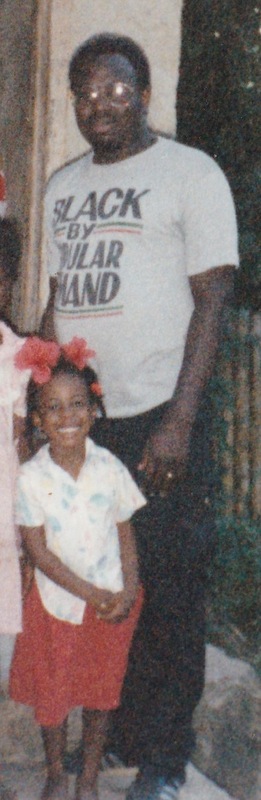
My “Black by Popular Demand” Dad and me, during my 1st trip to Jamaica

Although my father may not have always loved me in the way that I would have liked to receive it, he certainly taught me how to love myself.  Today, on Father’s Day, I thank my Dad for teaching us how to love ourselves, which is, as Whitney Houston declared, the greatest love of all.  Now, as a grown woman, I realize just how fortunate we were to have a father who made sure that we not only knew—but more importantly, that we also loved—who we were.  I thank him for giving us the affirmation that we would need to survive, living in a world where everyone and everything continually tells us that something is wrong with who we are and how we look. I attribute much of my success today to having a strong sense of self and confidence, which made me feel that I could do anything! So, for that, Dad, I thank you!

To all of the fathers out there, Happy Father’s Day!  Keep loving on your children.  Remember to tell them who they are, and who you know that they can be, to counteract the lies that society tells us.  The things you say about your children stick—words have power—so be mindful about what you say to them, both implicitly and explicitly, about themselves.  Teach them to love themselves, so that they won’t have to look for affection and acceptance in the wrong places.  Always affirm them, so that they can face the world with the confidence that they will need to succeed.  Your kids love and are counting on you!

My father, back in the day

My father, back in the day

I believe the children are our future
Teach them well and let them lead the way
Show them all the beauty they possess inside
Give them a sense of pride to make it easier
Let the children’s laughter remind us how we used to be…

Because the greatest love of all
Is happening to me
I found the greatest love of all
Inside of me
The greatest love of all
Is easy to achieve
Learning to love yourself
It is the greatest love of all

(Excerpt from “The Greatest Love of All”, written by Michael Masser and Linda Creed)

Happy Father’s Day! How did you celebrate your father today?


Tress Stress – Pt. II (or “Can I Wear this Hair to Work?”)

pro·fes·sion·al

prəˈfeSH(ə)n(ə)l/

adjective

1. 
of, relating to, or connected with a profession.

2. (of a person) engaged in a specified activity as one’s main paid occupation rather than as a pastime.

noun

1. 
a person engaged or qualified in a profession.


cor·po·rate

ˈkôrp(ə)rət/

adjective

1. 
of or relating to a corporation, especially a large company or group.

noun

1. 
a corporate company or group.


As if being a professional isn’t already stressful enough!

Have you ever questioned whether your boss is going to like your new hair(do)? Or whether you should wear your hair like “this” to an interview? Or even pondered how you’re going to explain to your colleagues how your hair magically went from being so short to growing back so fast, all within a matter of days?

For the textured-haired professional, these sorts of considerations are often the norm. As such, hairstyle choices can be a source of great stress when working in a “professional” environment (as if being a professional isn’t already stressful enough!)


The corporate interview

While career sites encourage people to wear their hair in the way they feel most comfortable (as long as it’s clean and neat) for an interview, those with textured hair do not enjoy that same luxury.  I learned this lesson for the first time when I was in undergrad, while I was a part of an internship program called Inroads.  At Inroads, we, students of colour, were being groomed for successful careers in the corporate world.  During our Impression Management session, the facilitator spoke to us about our suits, our shoes, the colours that we should wear…and, of course, our hair.

Our facilitator specifically pointed out that the Black interns should avoid wearing braids or cornrows to their interviews. I stood up and asked her what were those of us with natural hair expected to do, since braided styles were often all we wore. She explained to me that we could wear our hair braided, as long as the braids were neat and pulled back. It was her recommendation, however, for us to avoid such hairstyles altogether, lest we forfeit a job opportunity simply because of our hairdo.

I was flabbergasted.

My McGill Law graduation photo. My go-to back then were single extension braids.

My McGill Law graduation photo. My go-to back then were single extension braids.

While I understood the rationale for pulling back your hair back from your face (to allow the interviewer to see you without distractions and to deter you from perhaps playing with your hair out of nervousness), what I did not understand was why, if my hair was clean, braided neatly, and pulled back, it would not be “professional” enough.  Boy, was I naïve to think that my résumé, transcripts, poise, and tidy appearance would be sufficient to land a job!  I thought that what was inside my head was much more important than what was on top of it.  Sadly, this is not the case: your hair matters!


My slicked-back interview bun

My slicked-back interview bun

These days, my day-to-day hairstyles are usually two-strand twists, a twist-out, or an Afro; and, on occasion, I’ll have my own hair cornrowed or braided with extensions.  However, when I go for interviews, my go-to style is usually a slicked-back bun.  I don’t risk the braids, twists, or wearing it out because I don’t want to ruin my chances of landing the job.  There have been times when I have said to myself, “Well, if they [prospective employer] don’t like my hair the way it is, then maybe I shouldn’t work there”.  But then I catch myself.  I figure, “maaaaybe it’s better for me to get the job first, and then ‘feel them out’ to see if they’re gonna be okay with my hair”, rather than have myself counted out of the running from the beginning—just because of my hairstyle choice.


At my Call to the Bar (Swearing-In) ceremony

At my Call to the Bar (Swearing-In) ceremony

Side view - Call to the Bar 'do

Side view – Call to the Bar ‘do

Back view - Call to the Bar 'do

Back view – Call to the Bar ‘do


On the job

So, once you get the job, what happens next? You’re obviously expected to look “professional” on a day-to-day basis.  The problem is, by default, most “Black” hairstyles are considered to be unprofessional.

Although textured-haired professionals went to the same schools and work just as hard as their straight-haired counterparts, many times our capabilities and our corporate “fit” are questioned on the basis of our hairdos.  Why? Because braids, ‘locks, and other “ethnic” hairdos carry certain negative connotations: they are perceived to be political, threatening, or examples of “unkempt” hair.

And then there’s the double-standard…Unlike straightened hair, natural hair cannot be worn down- it’s worn out! While it is acceptable for a straight-haired woman to wear her hair down in the office, which is  equivalent to me wearing mine in an Afro, there are only certain corporate settings which would accept an Afro as a “professional” hairstyle.

Then, there’s the mystique of the “ever-changing hairdo”.  Black women are by no means the only ones to wear extensions or hairpieces, but somehow, we manage to baffle people every time we decide to change our ‘dos (I’m guessing it’s because of the frequency?)  I have tried to be patient with my responses to queries about the “dynamic” nature of my hair growth, using them as teaching moments; but I would be lying if I said that sometimes I don’t find it annoying, having to explain why my hair was short on Friday and then super-long on Monday!


How do you wear your hair to job interviews or to work? Have you ever experienced tress stress in the workplace?