

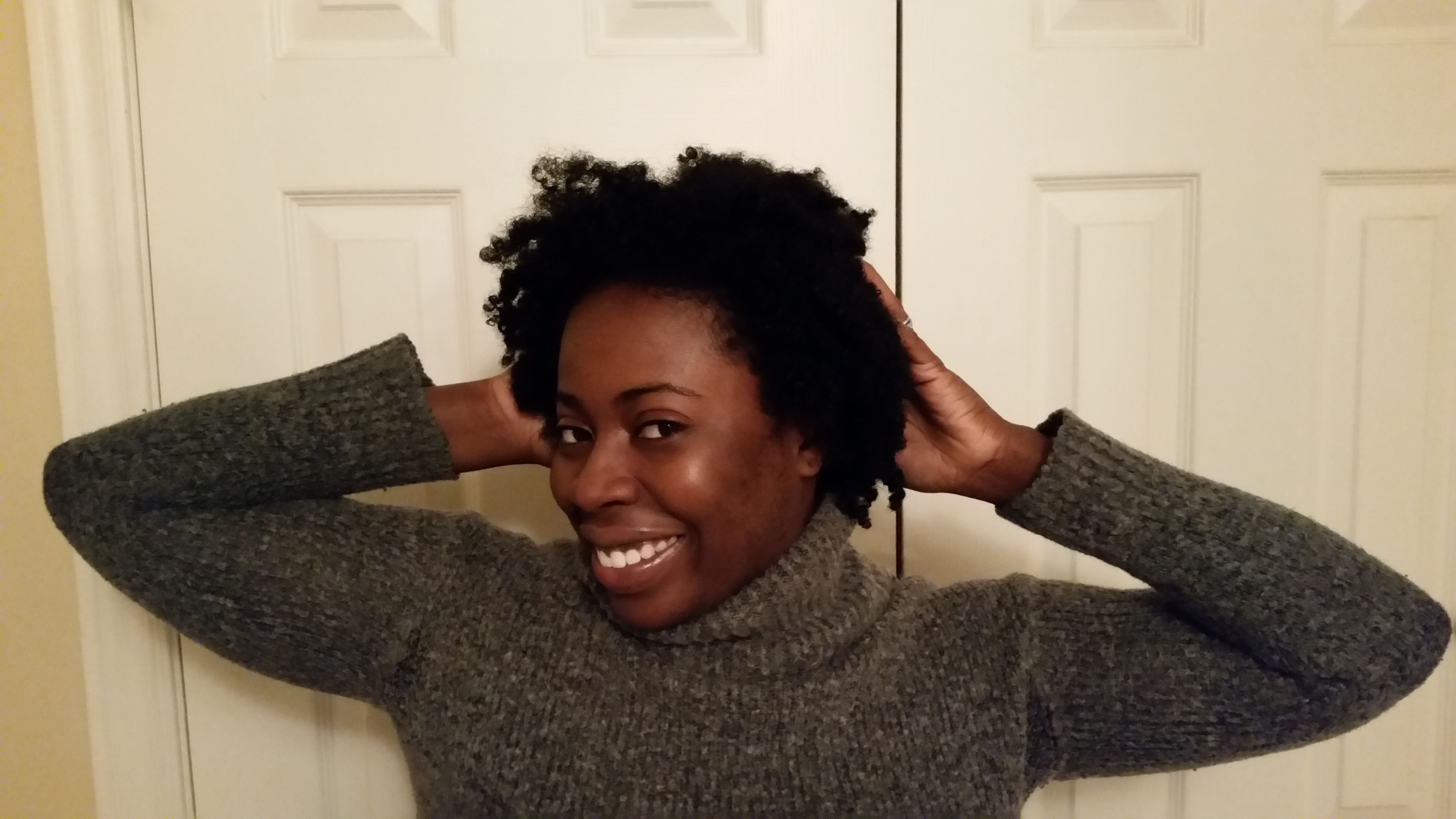
Me with my curly weave
It’s that time of year again when those of us who live in wintry climates hide our hair away in protective styles. Why? To protect our textured hair, which already has a tendency to be dry, from the aridity and harshness of the cold winter air. (For more on winter hair care, check out London Ivy Products’ Do’s and Don’ts of Protective Styling e-book and Dr. Susan Walker’s Cold Weather Curl Care webinar). Protective styles can be accomplished using one’s own hair (i.e. buns, cornrows, etc), but they are more often than not achieved with the assistance of artificial hair, such as extensions, weaves, and wigs.
Artificial hair (whether synthetic or human) is not only used for protective styling, but also to achieve styles that may require extra length and body; to provide a temporary colour change; or for pure maintenance reasons, because doing so cuts down on the amount of time needed for daily styling.
The funny thing is that people tend to make a big deal about Black women wearing fake hair (if and when it is even detected); yet, wearing false hair is nothing new! People have been wearing false hair since the time of the Ancient Egyptians, dating back to 3000 BC. Almost everyone in Ancient Egypt wore wigs or extensions made of black wool, cotton, human hair, palm-leaf fibres, or horse hair.
Nowadays, many women, of all walks of life and ethnicities, wear wigs or weaves; but I think the main thing that bothers people is when Black women wear fake hair that doesn’t look like their own.
As a matter of fact, last year, I had the following chat with a cousin of mine from Jamaica:
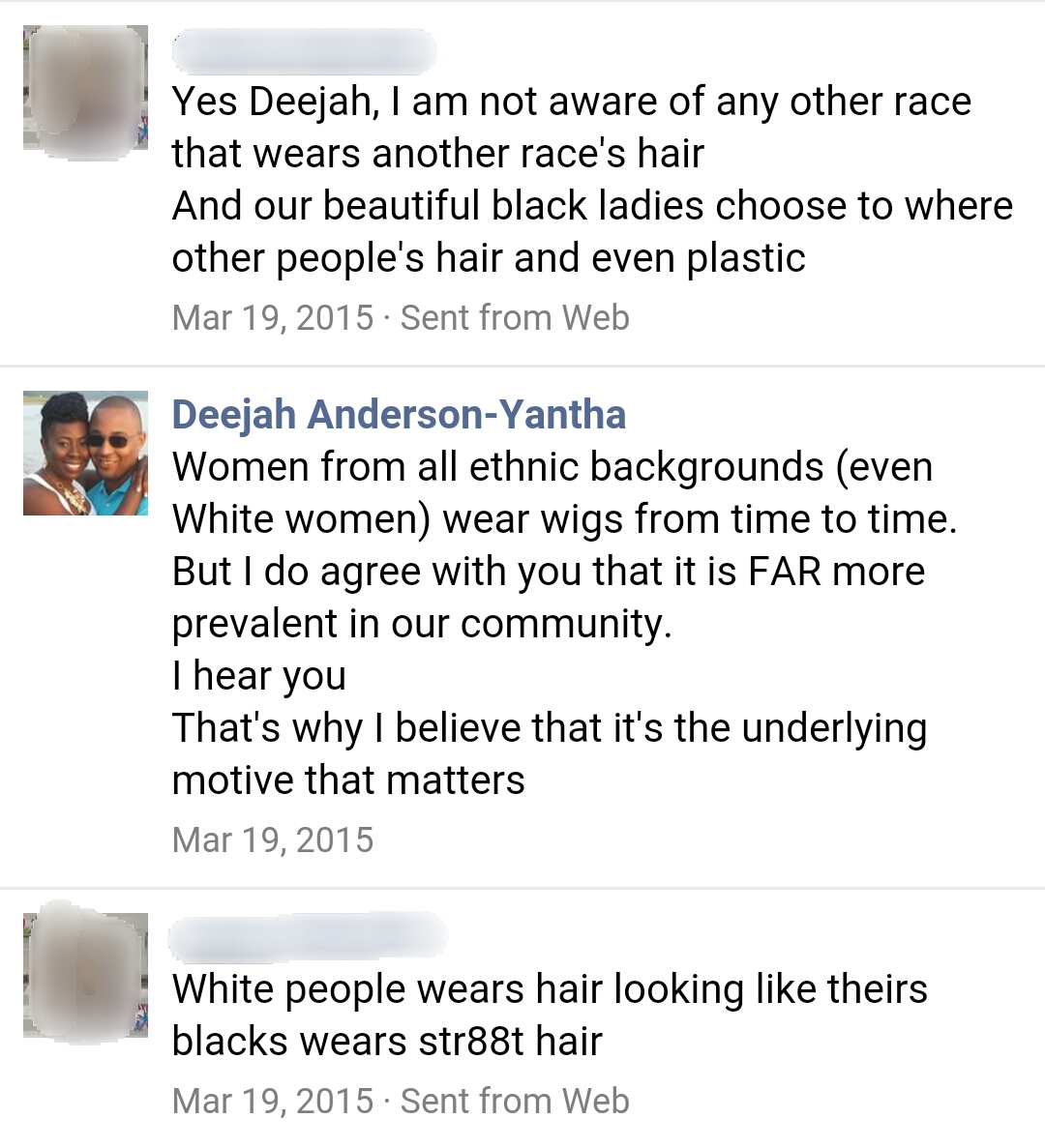


The statement that really gave me pause was:
“I am not aware of any other race that wears another race’s hair”.

Me with extensions; my sister Sarah wearing a wig
I began to think about it; and I had to admit that my cousin was right. Most hair pieces that I had seen (or even used myself) throughout my life were not made to imitate my kinky, coily hair: they were either too straight or too shiny. They were made to look “White”. And that was synthetic hair. When it came to human hair, there was nothing more desired than some long, sleek bundles of Asian hair.
Ever since weaves became popular in the ‘90s, the human hair industry has been booming: hair is purchased from Asian women who cut and sell (or are robbed of) their long hair, or is collected from temples in countries like India, China, Korea, and Indonesia; the hair is then processed in factories, and then sold to salons and beauty supply retailers in Canada, the United States, and the United Kingdom. (For more on where human hair pieces come from, click here to see a scene from “Good Hair” (2009), where Chris Rock heads to India (or “Weave Paradise” as he calls it) to investigate the source of the human hair industry, namely tonsure ceremonies at Hindu temples).
As my cousin rightly noted, before the Natural Hair Movement, there wasn’t really a demand for hair that looked like mine—it just wasn’t “stylish” enough, as seen in this other scene from “Good Hair” (2009).
Today, however, almost 7 years since the release of the film, things have certainly changed. Now, there is an increasing demand for hair pieces that look like natural hair, as Black women are embracing their own hair textures; and so retailers are beginning to provide for that need.
Keep ’em guessing
If you’re looking for some protective styling hair that emulates textured hair, check out these options:
1. Kinky Curly Yaki: http://www.kinkycurlyyaki.com
Kinky Curly Yaki is a Toronto-based company, which sells natural hair extensions and clip-ins. Their shipping time within Canada: 1-7 business days; to the U.S.: 1-8 business days; and to Europe and Australia: 2-10 business days; shipping rates vary.
2. Toni Daley: http://www.tonidaley.com/collections/wigs
Toni Daley sells natural hair half-wigs (along with other natural hair accessories), and is based in Toronto, Canada. She will ship to the Canada and the U.S. for $10 USD; to the U.K. for $18; France for $50; and Australia for $55. Shipping time within Canada: 5-7 business days; to the US: 10 – 12 business days; and to everywhere else: 10 – 14 business days.
3. Curl Genetics: http://www.curlgenetics.com
Curl Genetics is based in the U.S. and sells natural hair weaves, clip-ins, and wigs. They will ship to international addresses for a flat rate of $35 USD. Shipping time is about 3-7 business days.
4. Kurly Klips: http://kurlyklips.com
Kurly Klips is a natural hair clip-in company based in Washington, D.C. They will ship to Canada for about $25 USD. Shipping time can take up to 6 weeks for international shipments, and international shipping rates vary.
Sources:
Sagay, Esi. African Hairstyles: Styles of Yesterday and Today. London: Heinemann Educational Books, 1983.
Sherrow, Victoria. Encyclopedia of Hair: A Cultural History. Westport, Connecticut: Greenwood Press, 2006.
What do you think about artificial hair? Is there something wrong with wearing fake hair that doesn’t look like your own?


 The Natural Hair Advocate